

Call a Specialist Today! 800-886-5787 Free Shipping! Free Shipping!


Fortinet Platinum Partner

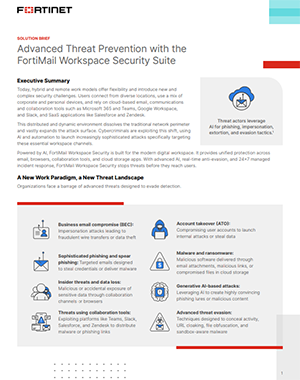
Why Workspace Security Now Requires Integrated Email Defense

The way people work has changed fundamentally. Security strategies once focused on email alone can no longer address the risks introduced by browsers, collaboration platforms, and a growing ecosystem of SaaS applications. Learn what integrated workspace defense means and why it matters.

Integrated Email Defense and Workspace Security

What was once centered on email and a corporate network now spans browsers, collaboration platforms, and a growing ecosystem of SaaS applications. Employees regularly switch between tools like document sharing platforms, messaging apps, and cloud-based business systems throughout the day. That flexibility drives productivity, but it also expands the attack surface in ways that many organizations are still working to fully understand.

Each of these touchpoints introduces its own set of risks. A malicious link clicked in a browser session, a compromised file posted in a collaboration tool, or unauthorized sharing of data within a SaaS application can all become entry points for attackers. When security strategies are focused on email alone, these additional avenues create blind spots that are difficult to detect and even harder to control.

This shift has forced security leaders to rethink what “workspace security” actually means. It is no longer confined to simply filtering incoming email messages or scanning attachments. Instead, it requires visibility and protection across the entire digital workspace where users work and collaborate. As the workspace expands, so must the scope of defense.

Even within email itself, the threat landscape has changed. Attacks have become more targeted, more credible, and far more difficult to detect than they were just a few years ago.

Securing the tools your teams rely on every day

Microsoft Teams Teams
SharePoint SharePoint
Microsoft Edge Edge
Google Chrome Chrome
Firefox Firefox
Safari Safari
Google Drive Google Drive
Salesforce Salesforce
Zendesk Zendesk

The Evolution of Email Threats

Today’s email-based attacks are defined by precision, scale, and a level of realism that challenges traditional defenses. For instance, yesterday’s phishing campaigns have given way to highly targeted and convincing attacks that leverage automation and AI. The following are key tactics increasingly used by attackers.

01

AI-Generated Phishing

Click to learn more →

AI email security has become a necessary consideration because attackers are already using similar capabilities. They can generate realistic messages that mimic an organization’s tone, branding, and context with alarming accuracy. These messages often get past traditional filtering techniques because they don’t rely on obvious red flags like suspicious attachments or poorly written content.

02

Account Takeover

Click to learn more →

Once an attacker gains access to a legitimate email account, they can operate from within that trusted environment. This allows them to send internal phishing messages, request sensitive information, or initiate fraudulent transactions without raising immediate suspicion.

03

Brand Impersonation

Click to learn more →

Attackers can replicate domains, visual identities, and communication styles to create messages that appear indistinguishable from legitimate sources. Combined with AI-generated content, these campaigns are scalable and difficult to detect using legacy tools.

04

Malware & Ransomware

Click to learn more →

Malware and ransomware campaigns continue to build on the above tactics. Instead of relying solely on attachments, attackers increasingly use links that direct users to compromised websites or trigger downloads through browser interactions. These techniques blur the line between email security and browser security, highlighting how interconnected these environments have become.

While these threats still often originate in email, they rarely stay contained there. And that’s where traditional approaches begin to fall short.

Why Email-Only Security Is No Longer Enough

For years, organizations have invested heavily in email security solutions designed to filter threats before they reach the inbox. While those tools remain important, they were built for a time when email was the primary gateway into the enterprise environment.

Today, that assumption no longer holds.

Most email protection, such as the native capabilities offered by Microsoft 365 and Google Workspace, does not extend into the browser, where many attacks ultimately unfold. A user may receive a seemingly harmless message that passes email filtering inspection, only to encounter malicious activity after clicking a link. Without integrated browser security, that interaction often goes unmonitored.

Online collaboration presents another challenge. Platforms used for messaging, file sharing, and teamwork often operate outside the visibility of traditional email gateways. Users can share files directly with colleagues and paste links into chat sessions, and external participants can introduce risk without ever passing through email controls.

SaaS applications add yet more layers of complexity. Data is constantly moving between applications, sometimes without clear oversight. Users can share, download, or unwittingly expose sensitive information in ways that traditional tools are not equipped to track. This creates opportunities for both external threats and insider risk.

Insider risk protection is especially important to note in this context. Whether intentional or accidental, actions taken by trusted users can lead to data exposure or policy violations. When security tools operate in isolation, it becomes difficult to monitor and correlate user behavior across different environments and identify risky patterns or anomalies.

The result is a fragmented security posture. Each tool provides a piece of the puzzle, but no single solution offers a complete view of user activity or threat behavior across the workspace.

This fragmentation is exactly what modern attackers exploit — and it is why a new approach is required.

This is where solutions such as Fortinet FortiMail become relevant. Rather than relying solely on native email protections, organizations can add advanced email security that improves inspection depth, detection, and control as part of a broader defense strategy.

The New Security Requirement: Integrated Workspace Defense

Integrated workspace defense represents a shift from isolated security controls to a unified model that spans the entire user environment. By deploying workspace protection that integrates FortiMail’s advanced email defense with broader security capabilities, you can bring email, browsers, collaboration tools, and SaaS applications together under a single, coordinated framework.

At its core, workspace security must include protection across several key components.

Email Systems

Email security remains a critical layer, providing protection against phishing, malware, and other inbound threats. However, it must be connected to broader systems that can extend visibility beyond the inbox.

Web Browsers

Browser security allows you to monitor and control user interactions with web content, including links delivered through email or collaboration tools. This helps prevent malicious activity that occurs after the initial point of entry.

Collaboration Platforms

Collaboration security ensures that shared files, messages, and external interactions are continuously evaluated for risk. It brings visibility to environments that have historically operated outside traditional security boundaries.

SaaS Applications

To be most effective, SaaS security should work together with data loss prevention solutions to monitor how information moves across applications. Combined, they help identify unauthorized access, prevent data exfiltration, and enforce policies that protect sensitive information.

Insider risk protection ties all of these elements together by analyzing user behavior across the workspace. By identifying anomalies and patterns, you can detect potential threats that would otherwise go unnoticed.

What makes this approach effective is the integration itself. When these security components operate as part of a unified system, they can share intelligence, correlate events, and respond to threats in a coordinated manner.

AI-based email security and user behavior analysis enhance these capabilities by identifying subtle indicators of risk. Instead of relying solely on known threat signatures, systems can detect unusual activity based on context and behavior.

Automation further strengthens the model by enabling rapid response. When the integrated system identifies a threat, it can trigger immediate actions such as isolating a session, blocking access, or alerting security teams.

The result is a more comprehensive and proactive security posture. Instead of reacting to isolated incidents, you can understand and address threats as they move across the workspace.

Fortinet FortiMail Supports Integrated Email Defense

Fortinet FortiMail plays a critical role in strengthening not only the email layer but also the comprehensive security of your entire system. It is designed to augment the built-in protections of Microsoft 365 and Google Workspace by adding deeper inspection, advanced threat detection, and greater control over email traffic.

FortiMail enhances email inspection by analyzing message content, links, and sender behavior with more precision. This helps identify phishing attempts that rely on subtle cues rather than obvious indicators, including AI-generated messages and brand impersonation campaigns that can bypass standard filtering. It also strengthens protection against account takeover scenarios by detecting anomalous activity and suspicious communication patterns.

Fortinet FortiMail

Just as important, FortiMail supports a more layered approach to workspace security. Instead of operating in isolation, it integrates into a broader defense strategy that connects email security with browser, collaboration, and SaaS protections. This allows threat intelligence to be shared across systems and enables more coordinated responses when suspicious activity is detected.

By reinforcing email security within this integrated framework, you can close critical gaps, reduce reliance on any single control point, and better defend against threats that move across multiple parts of the workspace.

The Business Impact of Integrated Workspace Security

Adopting integrated workspace security is not just a technical improvement. It has a measurable impact on how you operate and manage risk.

Over time, these benefits contribute to a stronger overall security posture. Your organization becomes more resilient, better equipped to handle evolving threats, and more confident in your ability to protect critical assets. As these advantages become clearer, the case for integrated workspace defense continues to grow.

Reduced SOC Workload

↑ tap to expand

One of the most immediate benefits is a reduction in the security operations center's management burden. When security tools are integrated across the organization, they generate fewer isolated alerts and provide more contextualized insights. This allows your security team to focus on meaningful threats rather than spending time correlating data from multiple sources.

Improved Visibility

↑ tap to expand

With a unified view of user activity across email, browsers, collaboration tools, and SaaS applications, you can identify risks more quickly and respond with greater confidence. This visibility also supports better decision-making at both the operational and strategic levels.

Enhanced Data Protection

↑ tap to expand

By monitoring how information moves across the workspace and enforcing policies consistently, you can reduce the likelihood of data exposure. This is especially important in environments where users frequently share and access sensitive information across multiple platforms.

Secure Productivity

↑ tap to expand

With integrated workspace defense, employees can continue to use the tools they need without unnecessary friction, while security measures operate in the background to protect against threats. This balance between security and usability is critical for keeping day-to-day operations on track.

Moving Toward a Unified Security Model

The evolution of the modern workspace has introduced new challenges that cannot be addressed with legacy approaches. Email remains an important part of the security equation, but it is no longer the whole picture.

Integrated workspace defense provides a path forward by bringing together insider risk protection and robust security across email, browsers, collaboration platforms, and SaaS applications to create a cohesive framework. With the support of AI-driven detection and automated response, this approach enables you to stay ahead of increasingly sophisticated threats.

For security leaders, the next step is to evaluate how current tools align with this model and where gaps may exist. Understanding those gaps is the first step toward building a more unified and effective defense strategy.

See Where Workspace Defenses Fall Short.

Get a no-obligation assessment from a FortiMail specialist.

Cybersecurity Specialist