Overview:
FortiAI-powered and automation-driven centralized device management from a single console
FortiManager, integrated with FortiAI, provides automation-driven centralized management of your Fortinet devices from a single console. This process enables full administration and visibility of your network devices through streamlined provisioning and innovative automation tools, enhanced by AI-driven capabilities for configuration scripting, validation, and IoT vulnerability analytics.
Integrated with the Fortinet Security Fabric advanced security architecture and automation driven network operations capabilities provide a solid foundation to secure and optimize your network security. Built-in Fortinet factory default templates with best security practice and relevant network configuration for specific use cases.
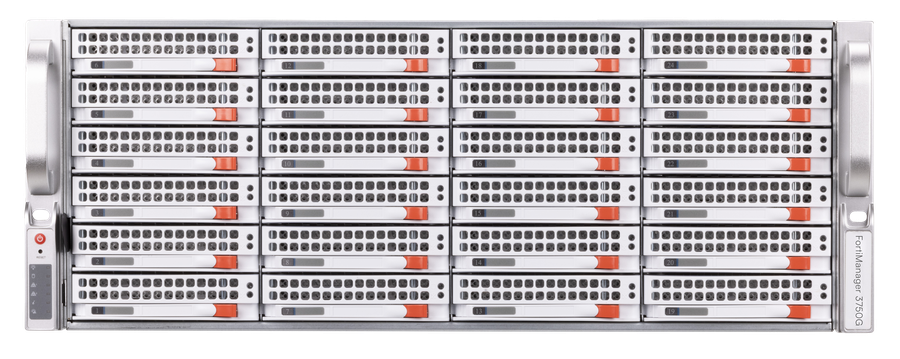
The FortiManager 3750G is the largest appliance in the FortiManager family, managing 10,000 devices/VDOMs by default and up to 100,000 with device add-on licensing, in a 4 RU chassis with 384 TB of SAS SED HDD plus 60 TB of NVMe SED SSD storage.
- Single-Pane Management and Provisioning simplifies centralized administration of policies and objects, while offering automated revision history and control. It also provides advanced role-based access control (RBAC) capabilities, allowing for distinct user roles in Firewall and Intrusion Prevention System (IPS) management.
- Fabric Automation simplifies the zero-touch provisioning (ZTP) deployment process for SD-Branch (FortiGates and access devices) with powerful templates that directly utilize metavariables for scalable provisioning to thousands of sites.
- Monitoring, Visibility, and Troubleshooting provides central monitoring and visibility for device inventory, applications, SD-WAN, LAN edge, network traffic, public cloud, and more. Built-in speed tests to troubleshoot branch office connectivity and packet capture to investigate LAN related issues.
Key Features:
- Centrally manage network and security policies for thousands of FortiGate NGFWs and Secure SD-WAN plus FortiSwitches, FortiAP, and FortiExtender. Provide updates to FortiGate, FortiMail, FortiSandbox, FortiClient, FortiNDR, as well as SIEM and SOAR content packages for FortiAnalyzer
- License management, centralized distribution of security content and signatures through the use of the built-in FortiGuard module which are designed to work in air-gapped networks
- Simplify configuration, deployment, and maintenance for Secure SD-WAN at scale
- Reduce complexity and costs by leveraging REST API, scripts, CLI and Jinja templates, connectors, and automation stitches
- Automate workflows and configurations for Fortinet firewalls, switches, and wireless infrastructure
- Separate customer data and manage domains leveraging ADOMs to be compliant and operationally effective
- Scale As You Go—Flexible design of FortiManager Fabric Cluster with Supervisor and up to 32 Members to increase performance in very large environments
Features:
Single-Pane Management
Single-Pane Management and Provisioning simplifies centralized administration of policies and objects, while offering automated revision history and control. It also provides advanced role-based access control (RBAC) capabilities, allowing for distinct user roles in Firewall and Intrusion Prevention System (IPS) management.
Zero-Touch Provisioning
Zero-touch provisioning simplifies the deployment process for SD-Branch (FortiGates and access devices) with powerful templates that directly utilize meta-variables for scalable provisioning to thousands of sites.
Fabric Automation
Our solution leverages automation and tight integration across Fortinet Security Fabric. With built-in FortiGuard update server, FortiManager delivers real-time security updates and protection to managed devices. By integrating ZTNA and SASE capabilities, we can enforce consistent security policy across different network topologies, independent of users’ locations.
Centralized analytics and logging through FortiAnalyzer provide end-to-end visibility and the APIs and Fabric Connectors enable integration and end-to-end automation, to reduce operational overhead.
FortiManager High Availability (HA) with Automatic Failover (VRRP)
FortiManager high availability (HA) provides enhanced reliability, data protection, redundancy, and operational performance to ensure agreed-upon uptime and availability requirements are met, with option for dedicated interface for management of the individual cluster member. In the event that the operating FortiManager unit fails, a backup FortiManager (one primary and up to four secondary) unit can take the place of the failed unit, for seamless access to devices and business-critical network operations.
Monitoring and Troubleshooting
Central monitoring and visibility for device inventory, applications, SD-WAN, LAN edge, network traffic, public cloud, and more.
Built-in speed tests to troubleshoot branch office connectivity and packet capture to investigate LAN related issues.
Generative AI-assisted Operations
FortiAI-Assist built in FortiManager consolidates central management, AI, and automation in one platform helping NOC teams to simplify Day-1 configuration with assisted scripts and syntax validation, auto-generation of SD-WAN configuration, provisioning templates, and firewall policies.
AI-Assist speeds up network troubleshooting with SD-WAN and overlay VPN diagnostic and remediation. It also provides IoT detection and vulnerability analysis, generates IoT reports and assists with quarantining compromised end devices.
Specifications:
| Particulars |
FortiManager 3100G |
FortiManager 3750G |
| Devices/VDOMs (Default)1 |
4000 |
10,000 |
| Devices/VDOMs (Maximum)3 |
8000 |
100,000 |
| Sustained Log Rates |
150 |
150 |
| GB/day |
10 |
10 |
| Storage Capacity |
64 TB (16 x 4TB) SAS SED HDD + 3.84 TB (2x 1.92TB) NVMe SSD |
384 TB (24 x 16TB) SAS SED HDD + 60 TB (4 x 15TB) NVMe SED SSD |
| Usable Storage (after RAID) |
56 TB |
336 TB (RAID 50, group 3 as default) |
| RAID Levels Supported |
RAID 0/1,1s/5,5s/6,6s/10/50/60 |
RAID 0/1,1s/5,5s/6,6s/10/50/60 |
| Default RAID Level |
50 |
RAID 50 |
| Hardware Form Factor |
3 RU Rackmount |
4 RU Rackmount |
| Total Interfaces |
2x GbE RJ45 ports, 2x 25GbE SFP28 ports |
2x 10GbE RJ45 and 2x 25GbE SFP28 |
| Console Port |
DB-9 |
DB9 |
| Self-Encrypting Drives (SED) |
|
|
| IPMI Sensors* |
|
— |
| Removable Hard Drives |
|
|
| Redundant Hot Swap Power Supplies |
|
|
| Trusted Platform Module (TPM)2 |
|
|
| Height x Width x Length (inches) |
5.2 x 17.2 x 25.5 |
7 x 17.2 x 27.5 |
| Height x Width x Length (cm) |
13.0 x 44.0 x 65.0 |
17.8 x 43.7 x 69.9 |
| Weight |
69.6 lbs (31.57 kg) |
70 lbs (31.8 kg) |
| AC Power Supply |
100-127V~/10A, 200-240V~/5A |
180-240Vac, 11-8A, 50-60Hz |
| Power Consumption (Average / Maximum) |
395 W / 510 W |
1134 W / 1474 W |
| Heat Dissipation |
1740.19 BTU/h |
5029.5 BTU/h |
| Operating Temperature |
32°F to 104°F (0°C to 40°C) |
50°F to 95°F (10°C to 35°C) |
| Storage Temperature |
-40°F to 158°F (-20°C to 70°C) |
-40°F to 158°F (-40°C to 70°C) |
| Humidity |
5% to 95% non-condensing |
10% to 93% non-condensing |
| Forced Airflow |
Front to Back |
Front to Back |
| Operating Altitude |
Up to 13,123 ft (4000 m) |
Up to 10,000 ft (3048 m) |
| Safety Certifications |
FCC Part 15 Class A, RCM, VCCI, CE, BSMI, KC, UL/cUL, CB, GOST |
FCC Part 15 Class A, ISED, CE, RCM, VCCI, BSMI (Class A), UL/cUL, CB |
1 Each virtual domain (VDOM) operating on a physical or virtual device counts as one licensed network device. Global policies and high availability support available on all models.
2 Gen2 refers to hardware that has been upgraded since initial release.
3 Devices/VDOMs maximum with device add-on license, if supported.
* IPMI Sensors: For FMG-3100G — sensors information available via OS, no IPMI physical port available.