FortiData for Data Security Posture Management
Overview: unifying visibility into your organization's sensitive data
Today’s most valuable currency is data. Whether it’s PII, PHI, customer cardholder information, intellectual property, strategic plans, or financial account details, data is the lifeblood of digital organizations. It must always be protected from theft or exposure by threat actors, malicious insiders, and careless or untrained employees.
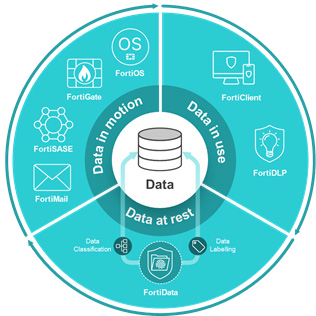
AI-powered FortiData works to bring together the full force of Fortinet’s data protection capabilities across the Fortinet Security Fabric to provide security teams with a complete view of their data security posture when it comes to protecting sensitive data in use, in motion, and at rest across their organizations. FortiData also complements other Fortinet solutions by discovering, classifying, and labeling to enhance data loss prevention.
Challenges: increasing complexity in managing and protecting sensitive data
Security and IT teams are faced with a two-fold challenge—their organizations are generating and collecting data at a rapid pace while the hybrid nature of today’s networks means that data sprawl is an acute problem. Meanwhile, the use of multiple security products and fragmented data security coverage, with policies separately configured and managed, exacerbate the challenge.
FortiData works to simplify data protection by discovering, classifying, and labeling sensitive data, enhancing data loss prevention across a customer’s use of the Fortinet Security Fabric, and providing centralized visibility into sprawl of sensitive data across an organization’s on-premises and cloud data stores.
Key Use Cases
- Discovers sensitive data at rest across hybrid environments
- Classifies and labels sensitive data based on predefined and customizable data types
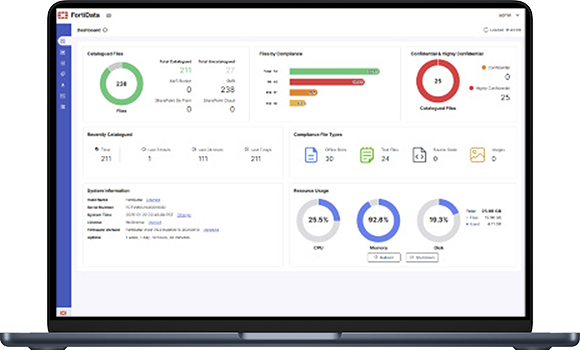
- Centralizes and dynamically visualizes your organization’s current data security posture
- Helps organizations comply with data protection requirements associated with major compliance frameworks
- Identifies sensitive data present in image files through OCR
Highlights:
Our Approach
FortiData is intended to unify data protection under a single dashboard to address the challenges associated with securing data in today’s complex hybrid environments. FortiData brings together powerful, automated data discovery, classification and labeling.
FortiData has one of the largest libraries of 400+ predefined data identifiers and 200+ data templates.
Centralized Data Visibility
For most Security and IT teams, visibility into data is fractured across multiple data stores and locations. FortiData is designed to discover and classify data across those disparate data stores to create a centralized view of sensitive data. Administrators can configure their own scans, reporting, and FortiData dashboard to prioritize visibility and alerting based on data sensitivity to the organization. FortiData extends data visibility to:
- On-premise data stores (SMB/CIFS file systems)
- AWS S3 Buckets
- Microsoft SharePoint Online data stores
- SharePoint on-premise
Data Security Posture Management
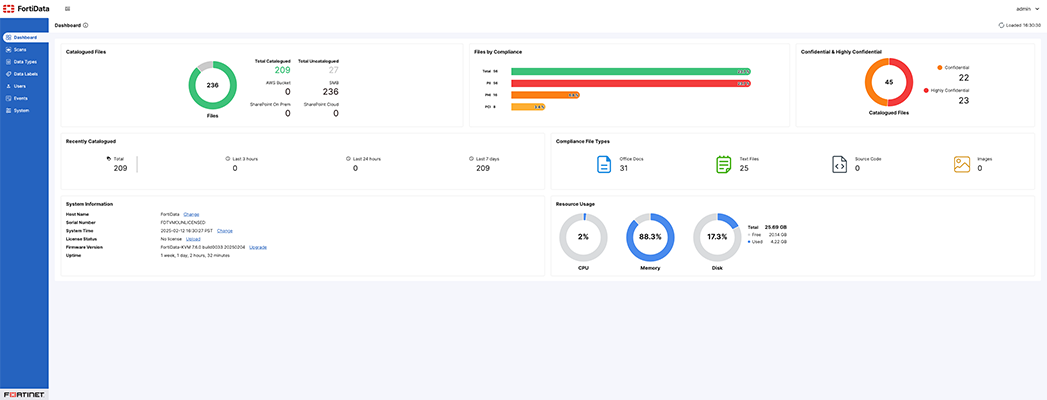
FortiData goes beyond discovery, classification, and labeling of sensitive data to centralize data visibility and provide administrators and leaders with an assessment of the current state of their organization’s data security posture. At a summary level, administrators can quickly identify areas for further review across data types or data labels—and drill down further for deeper analysis and investigation.
Broad Compliance, Privacy, Security Framework Coverage
FortiData gives administrators powerful functionality for discovering, classifying and tagging data associated with compliance, security, and privacy frameworks in place around the world. With 220+ predefined data templates tied to frameworks, administrators can customize scans for detecting data based on the specific frameworks that matter to their organizations. Meanwhile, administrators can quickly see what sensitive data exists and where at an executive view or drill down into specific repositories, classification labels, and files.
Enhanced with Artificial Intelligence
FortiData leverages advanced, pre-trained machine learning models for key industries such as Finance, Education, Healthcare, IT, and Manufacturing. FortiData also applies natural language processing and fuzzy detection technologies to improve detection and classification of sensitive data. Customer data is not used in the training of models for FortiData.
Use Cases
Data Discovery
FortiData performs data discovery across both on-premises (those using SMB/CIFS file systems and Microsoft SharePoint on-premises) and cloud-based data stores (Microsoft SharePoint Online and AWS S3 buckets).
Administrators can configure rules for scanning of data stores across their organization’s hybrid environment. They can also develop scans for specific types of data based on the FortiData extensive library of dictionaries.
Data Classification
FortiData applies machine learning and natural language processing technologies to optimize classification of sensitive data types including PII, PHI, PCI data, financial data, intellectual property, and code. Administrators can classify data based on predefined or custom labels. In addition, FortiData utilizes industry-specific trained data models for sensitive data types typically associated with Financial, Education, Healthcare, Information Technology, and Manufacturing industries.
Data Security Posture Management
FortiData provides centralized visibility through a single-pane-of-glass dashboard view into the current state of organization’s data security posture. Administrators can prioritize by data type to get an immediate sense of what data exists, the nature of that data, where it exists, and can drill down for more insights and review.
Comprehensive Regulatory and Industry Framework Coverage
FortiData helps Security and IT administrators comply with and report on adherence to data protection requirements associated with major compliance frameworks.
FortiData includes 220+ predefined data templates addressing data types associated with compliance, security and privacy frameworks. These templates allow organizations to identify and label appropriate sensitive data (PII, PHI, PCI cardholder data, and more) per a myriad of security and privacy frameworks including PCI DSS, HIPAA, CCPA, GDPR, ISO 27001, SOC 2, GLBA, SOX, and other frameworks spanning countries around the world.
Key Features:
- Performs data discovery, data classification, labeling, and data security posture visualization and management
- Uses advanced machine learning algorithms to fingerprint and scan files for sensitive structured and unstructured content whether the data is stored in the cloud (Microsoft SharePoint Online or AWS S3 buckets) or on-premises data stores (SMB/CIFS file systems and Microsoft SharePoint on-premises)
- Allows administrators to apply predefined or custom data labels to sensitive data
- Helps organizations comply with data requirements associated with major compliance frameworks
- Provides a centralized single-pane-of-glass view of an organization’s data security posture
- Enables stronger data loss prevention across the Fortinet Security Fabric through integrations and sharing of data classification labels
- Customers can protect data at rest, in use, and in transit through utilization of Fortinet Security Fabric data protection offerings and services
Documentation:
Download the Fortinet FortiData Datasheet (PDF).