Overview:
Application Delivery with Security and Optimization
In recent years, the landscape of application delivery has undergone significant transformations influenced by evolving technology trends and the increasing adoption of cloud computing. Many organizations are integrating on-premises data centers with public cloud environments to optimize application performance, enhance scalability, and improve overall business agility.
Introduction
FortiADC, the advanced Application Delivery Controller (ADC), optimizes application delivery, enhances performance, and ensures application security whether hosted on-premises or in the cloud.
The FortiADC 1000G delivers 50 Gbps of L4/L7 performance with hardware-based SSL ASIC acceleration, robust L4-L7 load-balancing capabilities with Scripting support for content manipulation, and Advanced SSL Services (Offloading and mirroring).
FortiADC also offers application acceleration, an Application Access Gateway (App Portal), and built-in security features like Web Application Firewall protection for any application threats with AL (Adaptive Learning), OWASP Top10 Compliance Policy, DDoS Protection, ZTNA, and more.
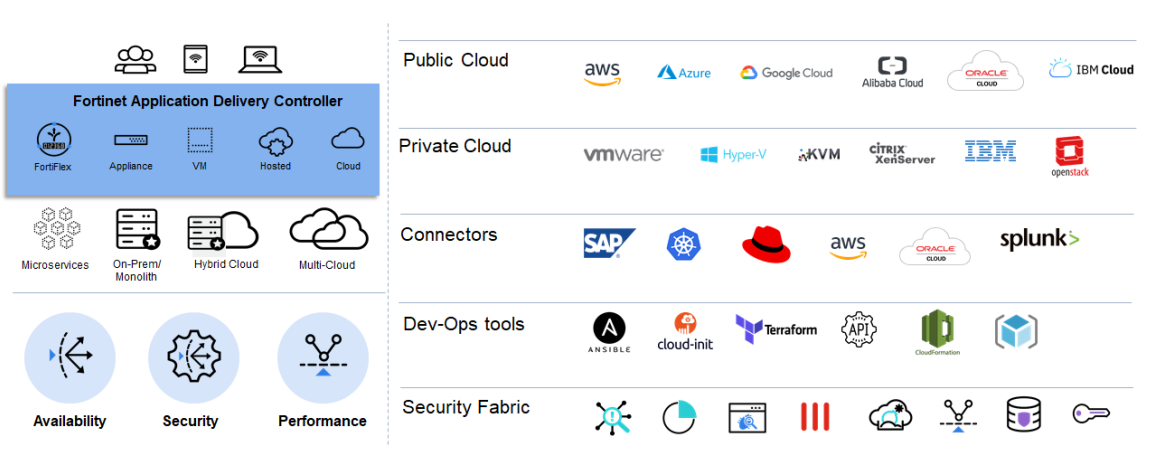
With flexible deployment options (HW, VM, FortiFlex, and Cloud Providers) and integration into the Fortinet Security Fabric, FortiADC empowers businesses to deliver exceptional application experiences and security.
Product Highlights
- Advanced L4‑7 Application LB
- FortiGSLB cloud integration maximizes service availability
- AL (Adaptive Learning), and OWASP Top‑10 protection and compliance with web application firewall
- An Application Access Gateway (AAG) securely provides agentless access to internal applications via a centralized portal with granular access policies
- Multi-deployment mode with hardware, VM, FortiFlex or Cloud providers (PAYG/BYOL)
- SSL security and visibility with hardware-based solution
- Automation and Fabric Connector to third party solutions such as K8s and OCP Ingress Controller, SAP, AWA and OCI
Highlights:
Application Availability
Applications are the lifeblood of a company’s online presence. Unresponsive applications can result in lost revenue and customers taking their future business elsewhere. Application performance, scalability, and resilience are key but none of this matters unless the end-user has a good experience and completes their transaction.
FortiADC is a dedicated Application Delivery Control solution that provides a multi-tenancy solution (VDOM and ADOM), high availability, and scalability with hybrid solution deployment (on-premises and cloud offering) to your applications.
Web Application Protection
FortiADC Web Application Firewall (WAF) provides a comprehensive security solution designed to protect web applications from a wide range of threats. Our WAF includes robust features such as AL (Adaptive Learning), which dynamically analyzes client and server traffic to build policies in real-time for blocking web attacks. In addition to adaptive learning, FortiADC WAF offers extensive WAF signatures, ensuring protection against the OWASP Top 10 vulnerabilities. It also includes advanced API security and safeguards against credential stuffing attacks, delivering a holistic and intelligent approach to application security.
Application Anywhere (GSLB)
The FortiADC included Global Server Load Balancing (GSLB) module on-prem or in the cloud (FortiGSLB Cloud) makes your network reliable and available by scaling applications across multiple data centers for disaster recovery or to improve application response times. Customers can set up rules based on site availability, data center performance, and network latency.
Data Optimization
FortiADC provides multiple services that speed the delivery of applications to users. The PageSpeed suite of website performance enhancement tools can automatically optimize HTTP, CSS, Javascript, and image delivery to application users. FortiADC also provides Dynamic Caching and HTTP Compression and Decompression to improve end-user experience and server productivity.
Agentless Application Gateway
The FortiADC Agentless Application Gateway provides secure, clientless access to internal applications via a web browser, eliminating the need for client-side agents. It supports multi-factor authentication (MFA) and single sign-on (SSO) for enhanced security. Administrators can create customized web portals, controlling access to applications based on user groups. With real-time session visibility, it ensures secure, efficient access for remote users without compromising performance.
AI Security
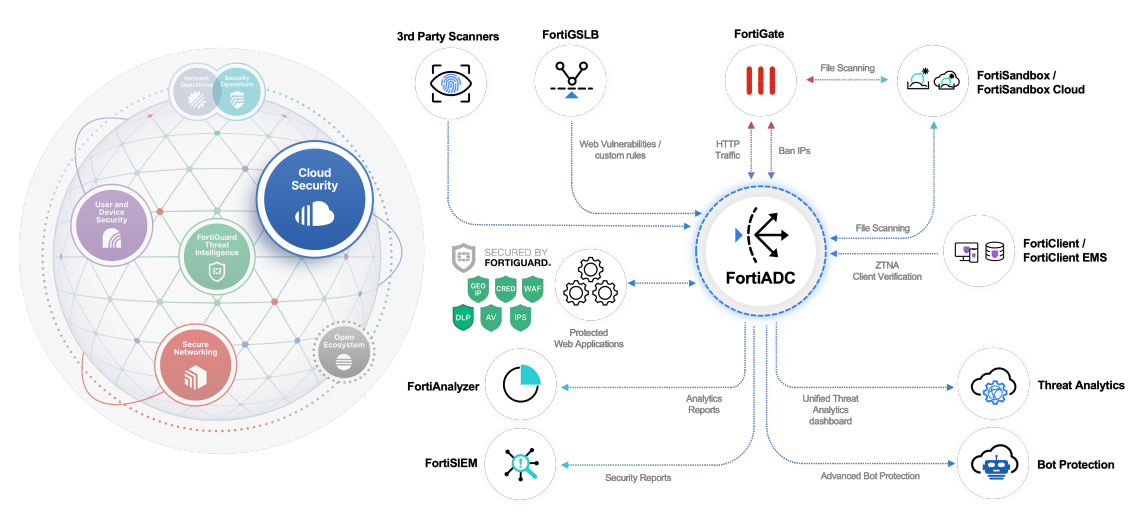
FortiADC now supports AI security with Threat Analytics and FortiGuard Advanced Bot Protection.
- Threat Analytics continuously assesses your security posture by monitoring attacks on your web assets and evaluating your WAF and Security configuration and, based on the Insights, provides recommended actions that can enhance your WAF and Security configuration settings, block future attacks, and reduce false positives.
- FortiGuard Advanced Bot Protection is a comprehensive defense against the ever-present threat of bots. It provides a cutting-edge SaaS solution to safeguard your web applications and digital assets from the everevolving threat of bots using client and server telemetry and deep learning.
Key Features:
Advanced Security Services
As the threat landscape evolves, many new risks require a multi-pronged approach for protecting applications. FortiADC provides multi-vector protections starting from the network— IPS, Antivirus, IP Reputation, and to the Applications—DLP, Sandbox, Credential Stuffing, and WAF Signatures, and up to AI Security with Threat Analytics and Advanced Bot Protection.
SSL Offloading and Visibility
FortiADC delivers high capacity decryption and encryption with the latest cryptography standard using hardwarebased SSL ASIC. FortiADC provides SSL offloading, SSL inspection and visibility to inspect traffic for threats, speeds up server response, and reduces the load on the backend server. FortiADC also integrates with Gemalto’s SafeNet Enterprise Hardware Security Module (HSM).
Scripts and DevOps Tools
FortiADC Scripts provides the flexibility to create custom event-driven rules using predefined commands, variables, and operators. Using easy-to-create scripts, you get the flexibility you need to extend your FortiADC with an advanced content rewrite and application decisions. FortiADC also offers a range of DevOps tools, such as RestfulAPI, Declarative API, Terraform, cloud-init, and Ansible, enhancing the efficiency of application deployment, management, and automation.
Automation and Connectors
FortiADC Fabric Connectors provide open API-based integration and orchestration with multiple software-defined networks (SDN), cloud, management, and partner technology platforms. Fortinet Fabric Connectors deliver turnkey, open, and deep integration into third party services such as K8s, AWS, OCI, and SAP, in multi-vendor ecosystems, enabling scalability, security automation, and simplified management.
Analytics and Visibility
FortiADC offers a comprehensive monitoring system for your network and application. With FortiView, customers can get real-time and historical data into a single view on your FortiADC. We also provide a network logical topology of real-servers, user/application data-analytics, security threats, attack maps, and some other system events and alerts.
FortiADC supports ADC Manager to manage multiple FortiADC devices remotely, and integrates with third party solutions such as Splunk, FortiAnalyzer, and FortiSIEM for more visibility, correlation, automated response, and remediation.
Security Fabric Connectors
FortiADC fabric connectors seamlessly integrate FortiADC with various Fortinet Security Fabric solutions, enabling automated processes for managing dynamic security updates without manual intervention. These connectors define the type of integration and facilitate a cohesive ecosystem for Fortinet products to work together harmoniously.
FortiADC supports a range of Security Fabric Integration with: FortiGate, FortiSIEM, FortiAnalyzer, FortiGSLB, Threat Analytics, and FortiGuard Advanced Bot Protection. The overarching goal is to enhance collaboration and automation across the Fortinet product suite through Fabric Connectors.
FortiAI-Assist
FortiAI-Assist embeds GenAI capabilities directly into FortiADC, enabling administrators to configure, troubleshoot, and optimize the system using natural language.
It provides real-time insights into traffic, logs, and system behavior, helping reduce operational complexity and accelerate issue resolution. In addition, the built-in Text2Script capability allows users to automatically generate FortiADC Lua scripts from simple prompts, enabling rapid creation of advanced traffic logic and automation without requiring deep scripting expertise.
FortiADC Features
| USE CASES |
SUPPORTED FEATURES |
| Application Availability |
Advanced L4-L7 Load-balancing (Application and protocols)
Presistency, Advanced Health-check, Content Routing, and Rewrite
Scripting Support and L7 Content Routing and Manipulation
SSL Advanced Services TLS1.3 (Offloading/Mirroring) and SSL Forward Proxy
SSL Management (client/server side) + Let’s Encrypt support |
| Application Anywhere |
Global Server Load Balancing (Geo-location, RR, Weight, and more)
Geo-IP Protection and IP Reputation
DNS Security and DNSSEC |
| Application Optimization |
Dynamic Caching and Compression
HTTP Page Speed (Optimization and Multiplexing) |
| Application Protection |
Web Application Firewall and Web Vulnerability Scanner
API Security (OpenAPI, API-GW, API Discovery)
WAF (AL) Adaptive Learning Support
FortiGuard Web Application Security Signature
Credential Stuffing Defense
OWASP top-10 Compliance
Advanced Bot Protection |
| Application Access Gateway |
Application Authentication — Form, Basic, and SSO
Agentless Application Gateway (WebTop)
SAML, Kerberos, OAuth2.0, LDAP, RADIUS, FortiToken, Google Auth, FortiAuthenticator, Azure EntraID
FortiGuard Cloud Sandbox
FortiGuard Data Loss Prevention |
| System and Networking |
VDOM/ADOM Support
Full NAT (1:1, Dynamic, Static, and Hide-NAT)
High Availability (VRRP A/A, A/P Failover)
IPv4 and IPv6 Support
Dynamic Routing (BGP, OSPF) and NVGRE and VXLAN Support |
| Networking Security |
DDoS Protection (Network and Application)
Stateful Firewall
Zero Trust Application Gateway
FortiGuard Intrusion Prevention
FortiGuard Malware (AV) Protection
ICAP Support |
| Data Analytics and SecOps |
FortiView — Data Analytics
OWASP top-10 Real Time Monitoring
Real Time Reporting, Monitoring, Logging, and SNMP
Threat Analytics AI
FortiAI-Assist |
| Fabric Integration and DevOps Tools |
Integration — SAP, K8s, OCP, AWS, MS (SharePoint, RDP, Exchange), Splunk, Cisco-ACI, and more
Security Fabric — FortiGate, FortiSIEM, FortiAnalyzer, FortiClient, FortiAuthenticator, FortiGSLB
Restful, and Declerative API, Ansible, Terraform, and Cloud-init |
| 24x7 Premium Support |
FortiCare Premium Support |
* Feature availability is dependent on the subscription to specific license bundles.
Specifications:
| |
FortiADC 1000G |
| L4/L7 Performance |
50 Gbps |
| L4 CPS |
1.1 M |
| L4 HTTP RPS |
4 M |
| L7 RPS |
1.5 M |
| Maximum L4 Concurrent Connection |
50 M |
| SSL Acceleration Technology |
ASIC |
| TLS Bulk Encryption Throughput |
35 Gbps |
| TLS TPS (ECDHE-RSA-AES256-GCM-SHA384) |
28 000 |
| TLS TPS (ECDHE-ECDSA-AES256-GCM-SHA384) |
57 000 |
| Compression Throughput |
25 Gbps |
| Virtual Domains |
Up to 60 |
| Memory |
64 GB |
| Network Interfaces |
8x 10G RJ45, 12x 10G SFP+ |
| 10/100/1000 Management Interface |
1 |
| HA Interfaces |
2 |
| Storage |
480 GB SSD |
| Management |
HTTPS, SSH CLI, Direct Console CLI, SNMP |
| Power Supply |
Dual (support Hot-swap PSU) |
| Trusted Platform Module (TPM) |
Yes |
| Width x Height x Depth (inches) |
17.32 x 1.73 x 22.68 |
| Width x Height x Depth (mm) |
440 x 44 x 576 |
| Weight |
23.69 lbs (10.75 kg) |
| Form Factor |
1U Appliance |
| Input Voltage |
100–240V AC, 50/60 Hz |
| Power Consumption (Average / Maximum) |
301 W / 362 W |
| Maximum Current |
100–127V / 7A, 200–240V / 3.5A |
| DC Power Supply |
Support |
| Heat Dissipation |
1027.05 BTU/h |
| Operating Temperature |
32–104°F (0–40°C) |
| Storage Temperature |
-4–167°F (-20–75°C) |
| Humidity |
10–85% non-condensing |
| Forced Airflow |
Front to Back |
| Regulatory Compliance |
FCC/ICES, CM, RCM, VCCI, BSMI |
| Safety |
UL/cUL, CB |
| Power Supply Efficiency |
80 Plus Platinum |
All performance values are “up to” and vary depending on the system configuration.